Machine Learning in Python: A Complete Beginner-to-Advanced Guide (2026)
Machine Learning in Python: A Complete Guide for Beginners
Artificial Intelligence is transforming industries faster than ever, and Machine Learning (ML) sits at the heart of this revolution. From Netflix recommending your next favorite show to banks detecting fraudulent transactions, machine learning enables software to learn from data instead of relying solely on manually written rules.
Python has become the world’s most popular language for machine learning because of its simplicity, rich ecosystem, and extensive community support. Whether you’re a software engineer, data scientist, or someone curious about AI, learning machine learning with Python is one of the most valuable skills you can develop.
In this guide, we’ll explore machine learning from the ground up, understand its core concepts, build our first model, and look at the tools and libraries professionals use every day.
What is Machine Learning?
Machine Learning is a branch of Artificial Intelligence that enables computers to identify patterns in data and make predictions or decisions without being explicitly programmed for every possible scenario.
Instead of writing hundreds of rules like:
1IF salary > 50,000
2AND age > 25
3AND experience > 3
4THEN approve loan
A machine learning model learns these relationships automatically by analyzing historical data.
Simply put:
Data + Learning Algorithm = Machine Learning Model
The more high-quality data the model receives, the better it generally becomes at making predictions.
Why Python is the Best Language for Machine Learning
Python dominates the machine learning ecosystem for several reasons.
Easy to Learn
Python’s readable syntax allows developers to focus on solving problems rather than learning complex language features.
1print("Hello Machine Learning")Compared to many programming languages, Python requires significantly less code to accomplish the same tasks.
Huge Ecosystem
Python offers mature libraries for nearly every aspect of machine learning:
- NumPy
- Pandas
- Matplotlib
- Scikit-learn
- TensorFlow
- PyTorch
- XGBoost
- LightGBM
- Hugging Face Transformers
These libraries eliminate the need to implement algorithms from scratch.
Massive Community
Millions of developers contribute tutorials, research papers, open-source projects, and documentation, making it easier to learn and troubleshoot problems.
Types of Machine Learning
Machine learning generally falls into four categories.
1. Supervised Learning
Supervised learning uses labeled data, where the correct output is already known.
Examples include:
- House price prediction
- Email spam detection
- Disease diagnosis
- Stock trend prediction
Popular algorithms include:
- Linear Regression
- Logistic Regression
- Decision Trees
- Random Forest
- Support Vector Machines
- Gradient Boosting
2. Unsupervised Learning
In unsupervised learning, the algorithm discovers patterns without labeled outputs.
Examples:
- Customer segmentation
- Product recommendations
- Fraud detection
- Data clustering
Popular algorithms:
- K-Means
- DBSCAN
- Hierarchical Clustering
- PCA
3. Reinforcement Learning
Reinforcement learning trains an agent through rewards and penalties.
Applications include:
- Robotics
- Autonomous vehicles
- Chess engines
- Video game AI
4. Deep Learning
Deep learning uses neural networks containing many layers.
Common applications:
- Image Recognition
- Face Detection
- Speech Recognition
- ChatGPT
- Self-driving Cars
- Medical Imaging
Popular Python Libraries
NumPy
Provides fast mathematical operations on arrays.
1import numpy as np
2
3numbers = np.array([1,2,3,4])
4print(numbers.mean())
Pandas
Used for cleaning and analyzing datasets.
1import pandas as pd
2
3data = pd.read_csv("students.csv")
4print(data.head())
Matplotlib
Creates charts and visualizations.
1import matplotlib.pyplot as plt
2
3plt.plot([1,2,3],[4,5,6])
4plt.show()
Scikit-learn
The most beginner-friendly machine learning library.
Supports:
- Classification
- Regression
- Clustering
- Model Evaluation
- Feature Engineering
TensorFlow
Developed by Google.
Ideal for:
- Deep Learning
- Neural Networks
- Computer Vision
PyTorch
Developed by Meta.
Widely used in:
- AI Research
- Large Language Models
- Computer Vision
Machine Learning Workflow
A professional machine learning project usually follows these steps:
- Collect data
- Clean the data
- Explore the data
- Engineer features
- Split training/testing data
- Select algorithm
- Train model
- Evaluate performance
- Optimize model
- Deploy model
Skipping any of these steps can significantly impact model quality.
Building Your First Machine Learning Model
Let’s predict house prices using Linear Regression.
1from sklearn.linear_model import LinearRegression
2
3X = [[1200],[1500],[1800],[2200]]
4y = [200000,250000,320000,400000]
5
6model = LinearRegression()
7model.fit(X,y)
8
9prediction = model.predict([[1700]])
10
11print(prediction)
Although simple, this demonstrates the core ML workflow:
- Train
- Learn
- Predict
Model Evaluation
Training a model isn’t enough—we must measure its performance.
Common metrics include:
Regression
- MAE
- MSE
- RMSE
- R² Score
Classification
- Accuracy
- Precision
- Recall
- F1 Score
- ROC-AUC
Choosing the correct metric depends on your business problem.
Feature Engineering
Features determine how well your model learns.
Examples:
Original Data
Engineered Features
- Month
- Day
- Weekday
- Holiday
- Quarter
Good features often improve model performance more than changing algorithms.
Avoiding Overfitting
Overfitting occurs when a model memorizes training data instead of learning general patterns.
Solutions include:
- More data
- Cross-validation
- Regularization
- Simpler models
- Early stopping
- Dropout (Deep Learning)
Popular Machine Learning Algorithms
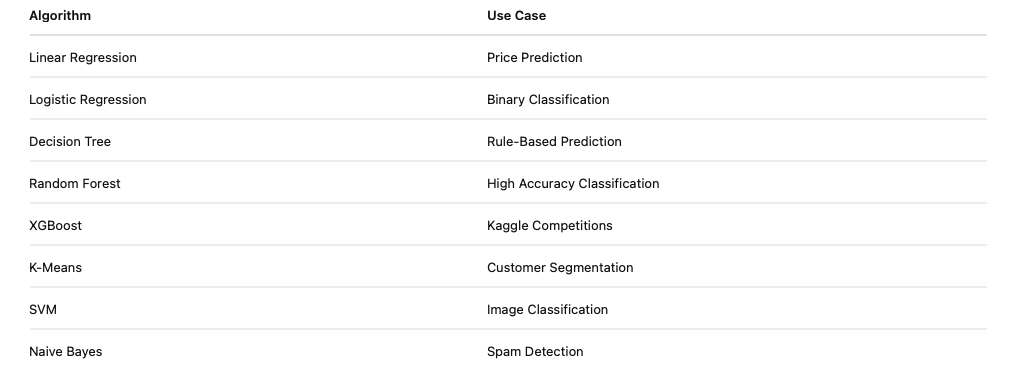
Real-World Applications
Machine learning powers countless applications across industries.
Healthcare
- Disease prediction
- Medical imaging
- Drug discovery
Finance
- Fraud detection
- Credit scoring
- Risk analysis
E-commerce
- Recommendation systems
- Dynamic pricing
- Customer segmentation
Manufacturing
- Predictive maintenance
- Quality inspection
Marketing
- Lead scoring
- Customer lifetime value prediction
- Campaign optimization
Common Beginner Mistakes
Many newcomers make avoidable mistakes, such as:
- Ignoring data cleaning
- Using too many features
- Training on small datasets
- Evaluating on training data only
- Choosing complex models too early
- Not understanding the business problem
Building a solid foundation with simpler models first often leads to better long-term results.
Learning Roadmap
If you’re starting today, here’s a practical progression:
Week 1–2
- Python fundamentals
- NumPy
- Pandas
Week 3
- Data visualization
- Statistics basics
Week 4–5
- Scikit-learn
- Regression
- Classification
Week 6
- Clustering
- Feature engineering
Week 7
- Model evaluation
- Hyperparameter tuning
Week 8+
- TensorFlow
- PyTorch
- Deep Learning
- NLP
- Computer Vision
- MLOps
Consistent hands-on practice with real datasets is the fastest way to improve.
Best Resources
- Scikit-learn Documentation
- TensorFlow Documentation
- PyTorch Documentation
- Kaggle
- UCI Machine Learning Repository
- Hugging Face
These platforms offer tutorials, datasets, and competitions that can strengthen both your knowledge and portfolio.
Final Thoughts
Machine learning is no longer reserved for researchers—it has become a core skill for software engineers, data scientists, and AI practitioners. Python’s simplicity, combined with its rich ecosystem of libraries, makes it the ideal language for building intelligent applications.
Rather than trying to master every algorithm at once, focus on understanding the fundamentals: how data is prepared, how models learn, how to evaluate performance, and how to deploy solutions that solve real-world problems. As your confidence grows, you can explore advanced topics like deep learning, natural language processing, and large language models.
The future of software is increasingly intelligent, and Python provides one of the clearest paths into that future. Whether your goal is to build recommendation engines, predictive analytics systems, computer vision applications, or AI-powered products, investing time in machine learning today will open doors to countless opportunities tomorrow.
Share this article
Found it helpful? Share it with your network.